
In a world where it feels like we’re constantly chasing optimization - the best workouts, the best longevity protocols, the best supplement stack, it is easy to forget that one of the most effective tools for fat loss is completely free and requires zero equipment.
It’s not a new program or new macro targets. It’s walking.
I also understand that walking doesn’t sound even the least bit exciting to many folks. For that reason, I think it can help us to understand our metabolism a bit more so that we understand why walking can make such a big difference in pursuit of body composition goals (or any goals, really!).
How Do We Actually Burn Calories? (A Quick TDEE Breakdown)
We must start with what's called our Total Daily Energy Expenditure (TDEE), or the total number of calories we burn each day. Think of TDEE as a pie with four slices — and your workouts are probably a smaller slice than you'd expect. Our TDEE has four parts:
Basal Metabolic Rate (BMR): The calories our bodies burn just to keep us alive: breathing, organ function, circulation. This is the largest component for most people.
Non-Exercise Activity Thermogenesis (NEAT): All the physical activity that isn't structured exercise: walking to the car, pacing on a call, fidgeting, taking the stairs.
Thermic Effect of Food (TEF): The energy our body uses to digest and process what we eat.
Exercise Activity Thermogenesis (EAT): Our actual workouts.
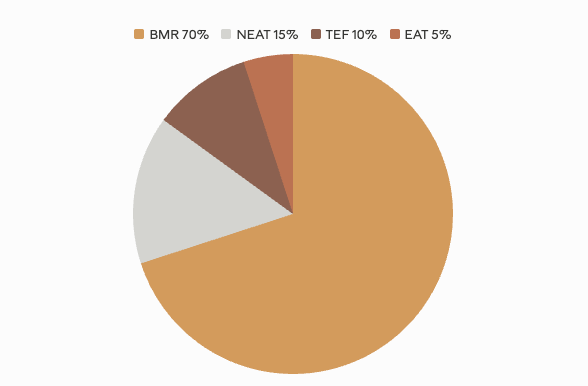
Here's the part worth thinking about most: structured exercise (aka the workouts you're carefully planning and logging!) typically makes up a smaller portion of your total energy expenditure than most people assume.
The point: your movement outside the gym matters a lot, and walking can be a big slice of our TDEE pie.
What Is NEAT — and Why Does It Matter for Fat Loss?
NEAT stands for Non-Exercise Activity Thermogenesis — all the physical activity that isn't structured exercise, like walking to the car, pacing on a call, fidgeting, or taking the stairs. It can account for anywhere from 5% to 30% of your total daily calorie burn, which for many people is as much or more than their gym sessions.
NEAT is worth dwelling on for a moment, because it's uniquely flexible in a way that other components of our metabolism aren't.
Your BMR is largely determined by your body composition and genetics.
TEF tracks pretty closely with what you eat.
Exercise has a ceiling since there are only so many hours in the day and so much your body can recover from (let’s be honest, most of us busy professionals are struggling to even find an hour here and there to work out).
But NEAT is highly responsive and the most modifiable component of your energy expenditure. Moving more throughout your day is one of the most effective ways to increase your total calorie burn and walking is the biggest, most accessible form of NEAT most people have available to them.
Research also shows that simply tracking your daily step count is an effective intervention for increasing NEAT. There's something about making movement measurable that makes it more intentional.
So… do I need to hit 10,000 steps per day?
10,000 steps originated from a Japanese marketing campaign in the 1960s, not from research on optimal health outcomes. The actual goal is simply moving more than you currently do — if you're averaging 4,000 steps, getting to 6,000 is meaningful progress.
The goal here isn't to hit an arbitrary number. The actual goal is simply moving more than you currently do. Find your baseline and build from there, or just think about moving a little bit more (tracking isn’t required!).
Why Walking Is So Effective for Fat Loss
Walking occupies a unique position in the exercise landscape. It’s particularly supportive to fat loss because:
It doesn't really impact appetite. Hard training can temporarily elevate cortisol and, for many people, increase hunger in ways that work against a calorie deficit. Walking doesn't carry the same physiological cost.
It's easy to recover from. Within reason, you can walk daily without it interfering with your workouts, your sleep, or your body's ability to recover.
It's stackable. Unlike a gym session that requires a dedicated block of time, walking can fit into the margins of our existing day.
Does Walking Actually “Count” as Exercise?
So many of us have been conditioned to associate effective exercise with sweat, soreness, and intensity, which is why we often overlook the value of walking. If it doesn’t feel hard enough to be “working,” we assume it isn’t!
What we must keep in mind: sustainable body composition changes shouldn’t require suffering. The most effective tools are the ones you'll actually use consistently over the long term.
A 30-minute walk every day for a year is going to outperform the workout program you quit after three weeks.
Walking is also genuinely good for metabolic health beyond just calorie burn. Improved insulin sensitivity, better blood glucose regulation, reduced cardiovascular risk, and lower stress levels are all documented benefits and things we want more of regardless of our aesthetic goals!
5 Ways to Add More Steps to Your Day
Walking is such a valuable health behavior and one of the first foundational habits I talk about with many of my clients when we start working together.
Some practical ways to increase daily movement without adding a separate "workout" to your schedule:
Post-meal walks. Even a 10-minute walk after meals has research support for improving blood glucose response. It's also a natural transition point in the day that's easy to build a habit around (hellooo habit stacking!)
Walking calls. Phone calls and virtual meetings that don't require you to be at a screen are an easy swap. Pace around your space or step outside instead of sitting.
Reframe your commute or errands. Park farther away, take the stairs, walk to a slightly farther to a different coffee shop. These feel trivial individually, but they add up meaningfully over the course of a day.
Make it enjoyable. Pair your walks with something you actually look forward to — a podcast, an audiobook, a playlist, a phone call with a friend. The walk becomes the vehicle for something extra enjoyable. As a big fan of audiobooks, this is my favorite walking “hack!”
Consider a walking pad or standing desk. If you work from home or have a desk job, these tools can dramatically increase your daily movement with minimal disruption.
Walking Pad Recommendations from the KLN Coaches
If you work from home or spend most of your day at a desk (like we all do), a walking pad can be a genuine game-changer. Here's what the KLN team is actually using:
Zach is currently using this Trailviber walking pad and recommends it, especially for use during meetings and long days on the computer. The price and quality are both great.
Kim: Had her initial walking pad break and this is the Akluer walking pad she replaced it with — no complaints!
Maria started with a budget-friendly Umay walking pad (under $200, no incline — a cheap pad with an incline made her nervous, and she just needed something to get the job done). That one's since been discontinued, and she's since upgraded to a NordicTrack 2150 — not a walking pad, but she loves it.
A basic flat pad you'll actually use beats an expensive one collecting dust every time. If you're budget-conscious, under $300 without an incline is a great place to start.
The Bottom Line: Start Where You Are
Walking is one of those rare tools that is simultaneously free, accessible, evidence-supported, and sustainable long term. It’s what I consider a “portable habit” - one we can take with us wherever we go.
This is your reminder that fat loss doesn't have to be complicated, and it doesn't have to be miserable. We can support our fat loss goals with small, doable behaviors each day rather than a full overhaul of our lives.
Ready to build on the basics?
If you're curious how your daily movement fits into the bigger picture of your nutrition and fat loss goals, that's exactly what we work through together inside KLN coaching. Learn more about working with us.

Kate Lyman
Leader, nutrition educator, and former chronic dieter helping clients rebuild their relationship with food, escape the cycle of yo-yo dieting for good, and cut through the overwhelm of nutrition misinformation.
You might also like

Sign Up for the newsletterFollow KLN on social media
Before jumping into another fat loss phase, it’s worth building the skills that make consistency in a calorie deficit feel less chaotic. We’re covering three foundational habits to practice first: creating meal structure, building filling plates, and returning to your routine without “starting over.”