
How an 85/15 Mindset Ends All-or-Nothing Dieting
Why mindset matters more than nutrition knowledge
Nutrition knowledge matters. Understanding protein, fiber, micronutrients, and calories gives you the tools to make better decisions. But in my experience as a coach, knowledge alone isn't what determines whether someone reaches their goals. Mindset is.
I've worked with clients who know exactly what they should be eating, but still struggle to make consistent progress because it’s hard to actually implement that knowledge.
I've also worked with clients who have very little nutrition knowledge, but who make steady, sustainable progress because their mindset around food is healthy and flexible.
The difference comes down to mindset.
When your mindset is flexible, you can be consistent without being perfect. And one evidence-based framework that supports this is the idea of a “discretionary calorie allowance”: meeting your core nutrition needs first, then leaving room for foods you enjoy without guilt.
What is a discretionary calorie allowance (and what 85/15 actually means)?
The Discretionary Calorie Allowance was introduced by the United States Department of Agriculture (USDA) in their 2005 Dietary Guidelines for Americans. These guidelines state that a person can meet their protein and fiber targets and consume sufficient micronutrients from roughly ~85% of their total calorie allotment. The remaining ~15% are considered discretionary, meaning they can come from added sugars, fats, alcohol, or more ultraprocessed foods without undermining overall health.
The idea is that once you’ve covered your nutrition “basics” (enough protein, fiber, and a solid base of minimally processed foods), there’s typically room for flexibility (foods you enjoy that aren’t as micronutrient-dense) without it meaning your overall diet is “bad.”
What 85/15 looks like in real life (a 2,000-calorie example)
Say you eat 2000 calories a day. If you hit your protein target, your fiber target, and get sufficient micronutrients from 1700 of those calories, the remaining 300 calories are yours to use however you want. That's roughly a scoop of ice cream, a drink or two, a slice of pizza, or whatever food brings you joy that day.
Those 300 calories are not “cheating.” They are not a failure. They are a built-in, scientifically supported part of a healthy, nutrient dense, and sustainable balanced diet.
Why all-or-nothing dieting backfires
Here's where mindset comes in. A lot of people approach their diet with an all or nothing approach.
Either they're eating clean, or they're not. Either they're on the diet, or they're off it. There's no middle ground.
The problem with that approach is it often leads to a shame cycle that actively limits long term progress.
In real life, this may look like: You go to a wedding. There's cake. You eat a slice because it's a wedding and the cake looks amazing and you're surrounded by people you love. But with an all-or-nothing mindset, instead of enjoying that experience, you spend the rest of the night feeling guilty. You tell yourself you already blew it, so you have another slice, and maybe a few more drinks and then some appetizers on the way out. By the end of the night the shame has snowballed into a full blown derailment, and you wake up the next morning feeling like you blew it and have to start over.
That shame cycle, not the slice of cake, is what limits your progress.
And here's something worth noting: in my experience with clients, when we don't have a restrictive relationship with food, we’re actually less likely to overeat it. It's the restriction that creates the obsession. If we give ourselves permission to enjoy the cake, we’re much more likely to have a slice or two, feel satisfied, and move on.
A spectrum, not a binary (and you don’t “have to” eat the 15%)
A flexible mindset recognizes that a healthy diet exists on a spectrum, not as a binary. That spectrum runs roughly from 85% to 100% whole and nutrient dense foods. (For my visual learners out there, here is a nice graphic from the USDA’s 2020-2025 Dietary guidelines). You have permission to be flexible!
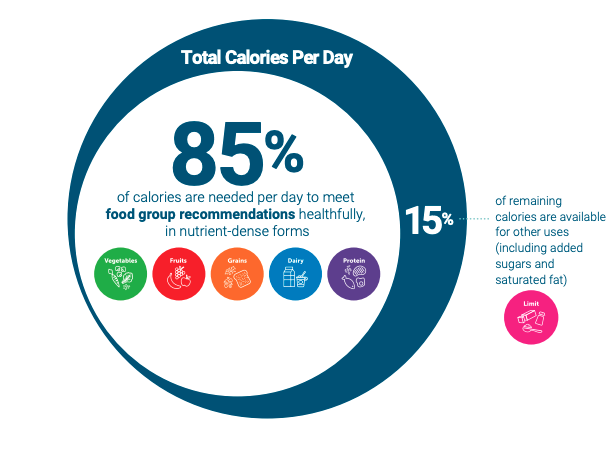
However, if you love eating whole foods and naturally gravitate toward ~100% of your calories coming from nutrient dense sources, that's great! You can keep doing that. You don’t have to leave 15% of your calories for less nutrient dense foods. Flexibility works both ways here and you can land wherever on the spectrum feels right to you.
But recognize that you have room to enjoy a treat, share dessert at a family dinner, or have a drink at a backyard barbecue without stepping outside the bounds of a healthy diet. The all or nothing mindset tells you that anything less than perfect is failure, while the results I see from my clients practicing flexibility say otherwise.
You don’t have to “earn” your ice cream
Cultivating a flexible mindset and taking a discretionary calorie approach doesn't mean you need to actively seek out processed food every day. If you naturally eat closer to 100% whole foods and that feels good to you, keep it up. The point isn't to make room for junk food. The point is to recognize that flexibility is part of a healthy diet, and that using it occasionally isn't a setback.
The ice cream cone on a hot summer day, the wedding cake, the pizza after a long work day, those aren't failures! They're part of a life well lived. And when we stop treating them as moral failures, we’re less likely to spiral into a shame cycle and all or nothing mindset that was holding us back in the first place.
A flexible mindset isn't a soft option or a woo woo idea and a Discretionary Calorie Allowance is a concrete example of what the science actually recommends.
Ready to build a more flexible relationship with food?
We believe that the best way to achieve your fat loss goals is working with a coach who creates a strategy specific to you - your needs, your preferences, your goals, and your lifestyle. Together we build the long-term nutrition habits that will support you for life. Find out more about our personalized approach.

Kenny Lyman
Dad and Hyrox athlete helping clients turn hard work into real results without falling for every shiny new diet trend.
You might also like

Sign Up for the newsletterFollow KLN on social media
Transitioning away from tracking macros does not have to mean deleting your tracking app overnight and hoping for the best. This post walks you through how to practice eating without tracking in realistic, confidence-building steps so you can keep the skills tracking taught you without relying on an app.